Healthy Habits
Small Daily Habits That Support a Balanced Lifestyle
A calm, practical look at how walking, sleep routines, hydration, and simple meals fit into an ordinary week.
By Hannah Reed · Medically reviewed by [Medical Reviewer Name, Credentials]
· 8 min read
Most daily routines are built out of very ordinary parts: the walk to a parking lot, the glass of water on a desk, what happens to be in the refrigerator on a Wednesday evening, and how late the lights stay on. None of it feels remarkable in the moment, and that is exactly why it is easy to overlook.
This article looks at a handful of everyday habits that many people find useful to think about — walking, hydration, sleep routines, simple meals, and quiet time — and how they tend to fit together over a normal week. It describes general practices only, in plain language, without assuming anything about any individual reader.
Why Small Daily Habits Matter
When people describe changing something about their day, they often picture a dramatic overhaul: a new schedule, a new grocery list, a new alarm time, all starting Monday. In practice, many people find that the parts of a routine that last are the small ones — the ones that fit into a day that already exists rather than replacing it.
Research on behavior change frequently points in the same direction. Habits tend to settle in when they are attached to something already happening: a short walk after lunch, filling a bottle when the coffee brews, putting a book where a phone usually sits. The cue is already part of the day, so the new step has somewhere to live.
A common approach is to pick one small thing and give it a few weeks before adding anything else. Some experts recommend choosing something so modest that skipping it would feel strange — a five-minute walk rather than a forty-minute one. The point is not the size of the step, but whether it survives a busy Thursday.
It is also worth noting what small habits are not. They are not a measure of discipline, and a week where nothing goes to plan is simply a week. Many people find it more useful to think in terms of returning to a routine than of keeping a streak intact.
“Habits tend to settle in when they attach to something already happening — the cue is already there, so the new step has somewhere to live.”
Movement: Building an Easy Walking Routine
Walking is the most widely available form of everyday movement. It needs no equipment, no membership, and no particular skill, and it can be split into pieces across a day. Public health guidance for adults generally describes accumulating moderate activity across the week rather than completing it in a single session, which means a walk does not need to be long to count toward the total.
A common approach is to start with a fixed, unambitious time slot — ten minutes after a meal, or a loop around the block before the workday begins — and to keep the slot consistent rather than the distance. People often find that the route matters more than the plan: a pleasant sidewalk, a park path, or a quiet neighborhood loop makes the habit easier to repeat than a longer route that requires a drive.
Things people often find helpful
- Keeping comfortable shoes somewhere visible near the door.
- Pairing the walk with something enjoyable, like a podcast.
- Walking with someone else, which adds a light commitment.
- Breaking the walk into two shorter ones when the day is full.
- Treating rain days as normal, not as a failure of the plan.
Comfort matters. Walking should feel like a pace at which conversation is still easy. Anyone with questions about what is appropriate for their own situation should talk with a qualified healthcare professional first.
Hydration Basics Through the Day
Fluid needs vary widely from person to person and depend on things like activity, climate, and what someone eats. General guidance from public health sources tends to avoid a single universal number and instead describes drinking regularly across the day, with water as the everyday default.
Practical routines tend to be about placement rather than counting. A bottle on the desk, a glass by the sink, water on the table at dinner — many people find these small logistics do more than a tracking app. Foods contribute too: soups, fruit, and vegetables all add fluid alongside everything else they provide.
Warm weather, travel, and longer walks are the situations in which people most commonly notice they have drifted away from their usual pattern. Carrying a bottle on those days is a simple, low-effort adjustment. Anyone who has been advised to follow a specific fluid routine should follow that guidance rather than general information.
How Sleep Quality Shapes Your Energy
Sleep shapes how the rest of a day feels — concentration, mood, appetite, and the willingness to go for that ten-minute walk. General guidance for adults describes a range of roughly seven to nine hours a night, though people differ, and one short night is a normal part of life rather than a problem to solve.
Most sleep-hygiene guidance focuses on consistency and environment rather than effort. Common suggestions include keeping a similar sleep and wake time across the week, dimming lights in the last hour of the evening, keeping the bedroom cool, dark, and quiet, and giving caffeine a wide berth later in the day.
A wind-down routine helps many people signal the end of the day: the same short sequence — tidy the kitchen, shower, read a few pages — repeated in roughly the same order. The details matter far less than the repetition. Persistent difficulty sleeping is worth discussing with a qualified healthcare professional.
“The details of an evening routine matter far less than the repetition — a familiar sequence is what signals the end of a day.”
Simple, Balanced Meals Without Overthinking
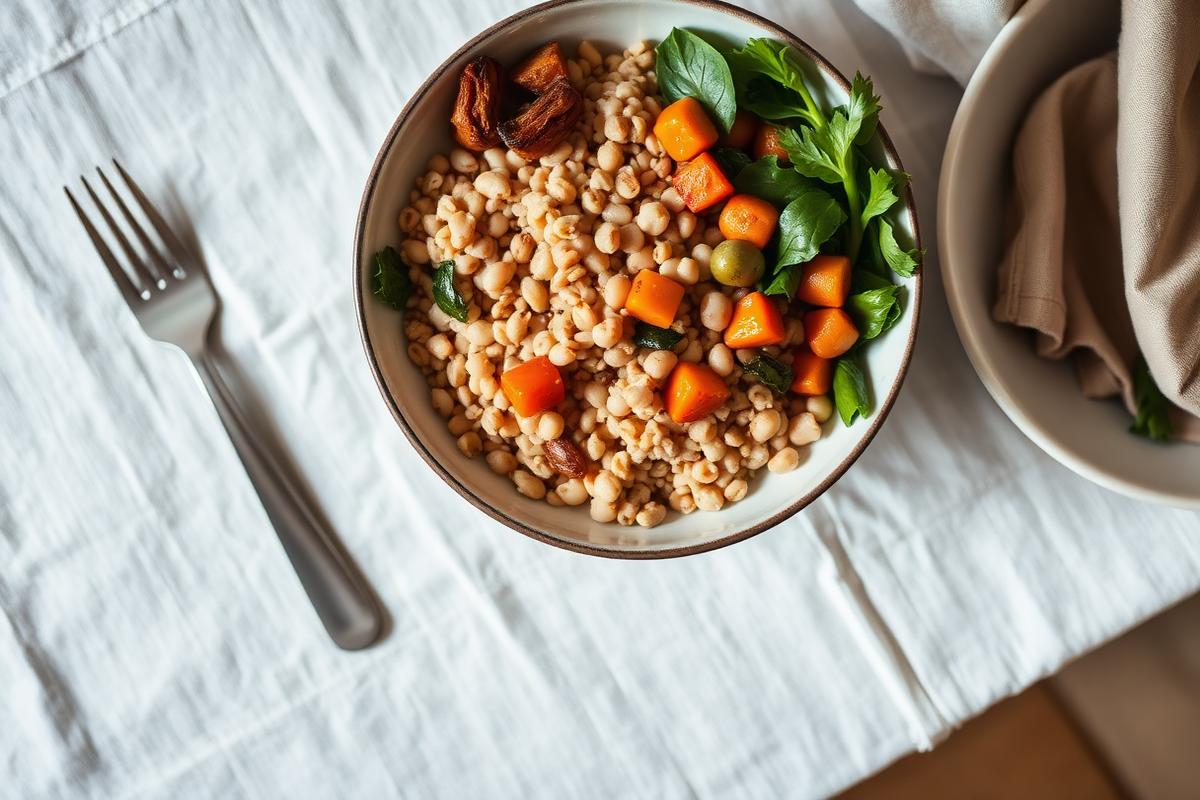
General nutrition guidance is usually described in terms of a plate rather than a program: roughly half vegetables and fruit, a quarter grains — often whole grains — and a quarter protein foods, with water as the standard drink. It is a rough shape, not a rule, and it works about as well for a lunchbox as for a dinner.
What tends to make weekday cooking easier is repetition. Many people keep a short rotation of five or six meals they already know how to make, and vary the vegetable or the grain instead of the whole dish. Keeping a few reliable staples on hand — frozen vegetables, canned beans, eggs, rice, oats — means an ordinary meal is possible on an evening when nothing was planned.
Eating patterns are personal, shaped by budget, culture, schedule, and taste. General information describes broad shapes; individual questions belong with a qualified professional who knows the whole picture.
Managing Everyday Stress
Ordinary pressure — deadlines, commutes, family logistics — is part of most weeks. Widely described approaches for everyday pressure are unglamorous: time outdoors, a few minutes of quiet breathing, gentle stretching, keeping in touch with people, and protecting a small part of the day that belongs to no one else.
Mindfulness practices are often described in the same terms as walking: short and regular beats long and rare. Five quiet minutes in the morning, a slow walk without a phone, or a few minutes of stretching before bed are the sorts of things people report actually repeating.
Daylight and outdoor time appear in a lot of general guidance, partly because they combine several of these things at once — movement, a change of scenery, and a pause. If everyday pressure feels persistent or overwhelming, speaking with a qualified healthcare professional is the appropriate next step.
Putting It Together: A Sample Daily Rhythm
None of these habits needs its own slot in a calendar. Most people find they overlap naturally across a day. The table below is one illustrative example of how ordinary habit ideas might distribute across morning, afternoon, and evening — not a schedule to follow.
| Morning | Afternoon | Evening |
|---|---|---|
| Glass of water on waking | Short walk after lunch | Unhurried dinner at the table |
| Consistent wake time | Refill the water bottle | Dim lights in the last hour |
| Breakfast with a protein food | Step outside for daylight | A few minutes of stretching |
| Five quiet minutes | Stand and stretch hourly | Consistent bedtime |
Read as a whole, the list looks like a lot. Read as a week, it is mostly the same handful of small moments repeating. Many people find that picking one column — or even one row — is enough to start with, and that the rest either follows or does not, which is fine either way.
Everyday habits are personal, and general information can only describe the broad shape of them. What fits into one week may not fit into the next, and a routine that works is usually one that bends.
Sources & further reading
- Centers for Disease Control and Prevention — Physical Activity Basics for Adults
- National Institutes of Health — Healthy Eating and Everyday Nutrition Guidance
- World Health Organization — Physical Activity and Sedentary Behaviour Guidelines
- Mayo Clinic — Sleep Habits and Daily Routine Overviews
References are listed as plain text for general reading.

Hannah Reed
Wellness writer at The Daily Balance
Hannah writes about everyday routines, food basics, and time outdoors.